AI Was Whispering the Answers During My Job Interviews. I Got 8 Out of 10 Offers.
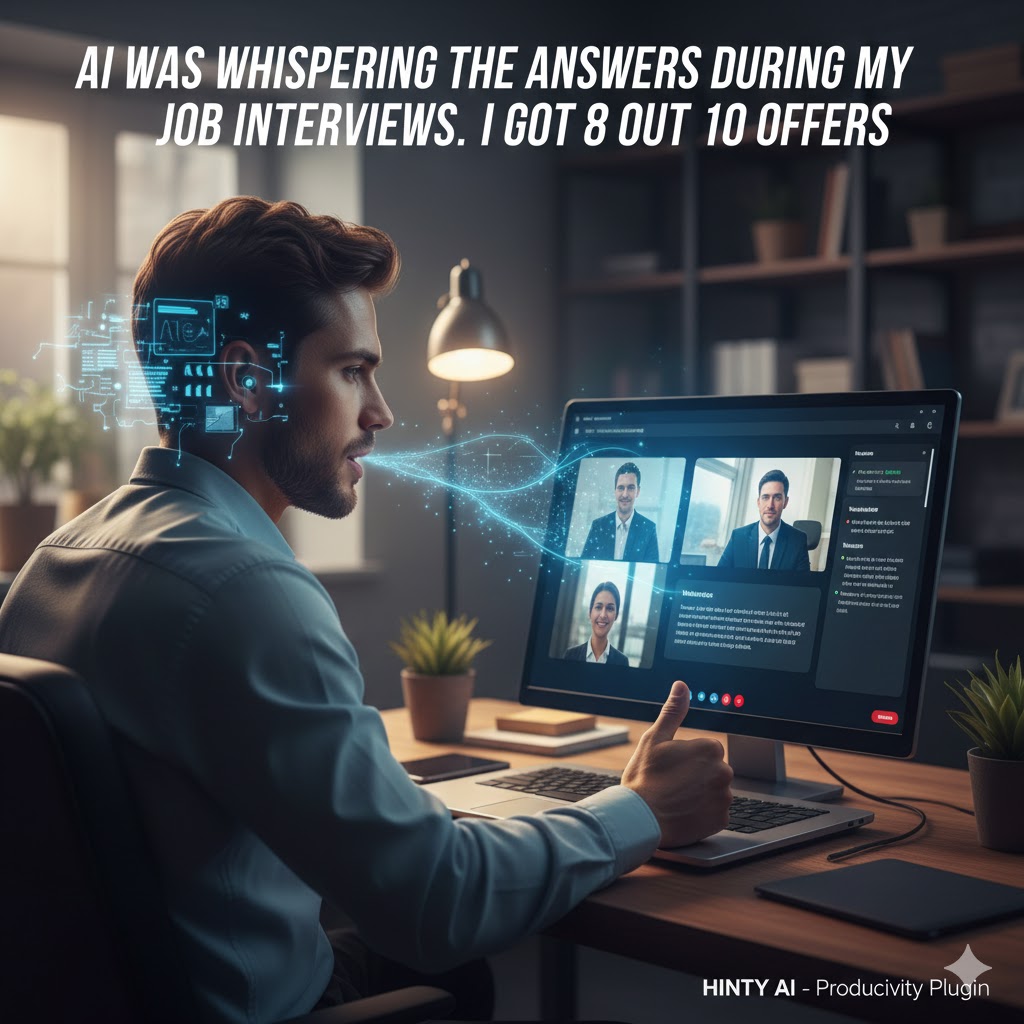
For the last four months, I've been using AI during my job interviews. Not to prepare. Not to practice. During the actual live conversation with the recruiter. An app on my phone was listening to every question and feeding me suggestions in real time.
My score? 8 out of 10 interviews passed. Four offers on the table. I accepted the best one three weeks ago.
Before you close this tab in disgust — give me five minutes. Because I think what I did was completely fair. And by the end of this post, you might agree with me.
My "Before" Stats Were Embarrassing
Let me rewind to January.
I'm a marketing specialist with 3 years of experience. Not a genius, not terrible. Solidly average. I know my way around Google Ads, I can write a campaign brief, I understand attribution models. On paper, I'm a decent candidate.
But interviews? Interviews destroyed me.
My track record before AI: 2 passes out of 12 interviews. That's a 17% success rate. Worse than a coin flip. Worse than guessing on a multiple-choice test.
And the frustrating part? I wasn't failing because I didn't know the answers. I was failing because my brain turned to soup the second someone asked me a question with a webcam pointed at my face.
Here's a typical example:
Recruiter: "Can you walk me through a campaign where you significantly improved ROAS?"
What I know: Yes. The Q3 e-commerce campaign. We restructured the audience targeting, switched from broad to lookalike audiences based on existing customer data, reduced CPA by 31%, and ROAS went from 2.8x to 4.1x over six weeks.
What came out of my mouth: "Um, yeah, so at my last company we did some optimization... on the campaigns... and the results were, um, quite good actually..."
Every. Single. Time.
I'd walk out of interviews wanting to scream, because I knew the answer. I just couldn't retrieve it under pressure. It's like having the file saved on your hard drive but the search function is broken.
How I Stumbled Into AI-Assisted Interviews
It was 11 PM on a Tuesday. I was doom-scrolling Reddit after yet another rejection email ("We've decided to move forward with other candidates" — the five cruelest words in the English language).
I found a thread in r/jobs where someone casually mentioned they used an AI tool during a video interview. The comment had 200 upvotes and 150 replies. Half the people were outraged. The other half were asking for the app name.
I was in the second group.
I tried a few approaches first:
Attempt 1: ChatGPT in a browser tab. Terrible. By the time I typed the question, waited for a response, and read it, there was a 20-second pause. The recruiter asked if my internet was okay.
Attempt 2: Pre-written answers on sticky notes. Better, but limited. You can't predict every question, and reading from a note sounds exactly like... reading from a note.
Attempt 3: An app that actually listens. This is where things changed. I found Hinty — an app that uses real-time speech recognition to listen to the conversation and suggest answers based on your actual experience (you upload your resume and documents beforehand).
The difference? Zero delay. The recruiter asks a question, and within 3-4 seconds, a suggestion appears on my phone screen. Not a full script — more like a nudge. Keywords, metrics, project names. The stuff my brain has but can't access when I'm nervous.
The 10 Interviews: A Blow-by-Blow Account
Interview 1: Marketing Manager at a SaaS Startup
My guinea pig interview. I was terrified — not of the recruiter, but of the setup. Would I get caught glancing at my phone? Would the AI be slow? Would the suggestions be useless?
I propped my phone on a small stand below my laptop webcam. Font size cranked up. Hinty running in Job Interview mode with my resume and the job description uploaded.
The CTO asked: "What's your experience with product-led growth?"
I froze. I know PLG concepts, but my mind went completely blank on specifics. Then I glanced down.
The suggestion: "Mention activation metrics, onboarding flow optimization, the sign-up to first-value conversion rate you improved."
I took a breath and started talking. Activation metrics. The onboarding funnel I rebuilt. The 23% improvement in sign-up to first-value conversion. These were my numbers, from my experience — I just couldn't pull them from memory under pressure. The AI could.
Result: Passed. Got an offer.
Interview 2: Content Lead at a Digital Agency
Panel interview. Three people on the call. The creative director threw a curveball: "Tell me about the worst campaign you've ever worked on and what went wrong."
This is a trap question. Most people either deny ever failing (unbelievable) or over-share the disaster (scary). The sweet spot is a structured failure story with a clear lesson.
The AI caught it instantly. Suggestion: "The Facebook campaign that over-indexed on reach with wrong audience. Budget burn: $4,200 in 2 weeks. Lesson: always validate audience with small test budget first."
That was a real screw-up from my second job. I'd completely forgotten the specific numbers. But I'd put them in my achievement doc, and the AI pulled them at exactly the right moment.
I told the story with actual dollar amounts, timelines, and what I changed afterward. The creative director nodded and said: "Good. We like people who can talk about failure specifically, not vaguely."
Result: Passed.
Interview 3: Digital Marketing Specialist at a Big Corp
Rapid-fire technical questions. Attribution models. Google Ads quality score factors. The difference between view-through and click-through conversions. Campaign budget optimization formulas.
The AI couldn't keep up with this pace — the questions were coming too fast, one every 30 seconds. But it caught key terms and reminded me of frameworks. "Mention last-click vs data-driven attribution — you presented this at the Q2 team workshop."
That memory trigger — the Q2 workshop — unlocked a whole chain of knowledge. I explained data-driven attribution using the exact example I'd presented to my team six months ago.
Result: Passed. (Just barely. I sweated through my shirt.)
Interview 4: Brand Manager at an FMCG Company
Before this one, I uploaded my portfolio case studies as PDFs. This was the game-changer.
When the interviewer asked about my approach to brand positioning, the AI didn't just suggest generic frameworks. It pulled from my own case studies and reminded me of the specific positioning matrix I'd created for a client.
I described my methodology using my own proprietary framework, with specific examples, like I had photographic memory. The interviewer said: "You're the first candidate who's come in with a clearly defined approach rather than just textbook answers."
If only she knew that I'd forgotten that framework existed until 4 seconds ago.
Result: Passed. Got an offer.
Interview 5: Growth Hacker Role at a Tech Startup
Failed. And honestly, the AI couldn't have saved me.
The interviewer asked me to share my screen and walk through a live campaign setup in Google Ads Manager. This is a practical skills test — you either know where the buttons are or you don't.
I was rusty on some of the newer interface changes. No AI can click buttons for you.
Lesson: AI helps with verbal answers. It doesn't help with practical demonstrations.
Interview 6: Marketing Coordinator (Stepping Stone Role)
Easy interview. The role was slightly below my experience level. But here's the thing — even easy interviews trip you up when you're anxious.
The recruiter asked standard questions: "Why this role?" "What are your strengths?" "Give me an example of teamwork."
Simple questions. But the AI did something clever — it reminded me to be specific instead of generic:
Instead of: "I improved email performance"
AI suggested: "Open rate 18% to 34%, 6-week A/B test on subject lines, 12% click-through improvement"
I rattled off specific numbers for every answer. The recruiter looked surprised. For a coordinator role, nobody comes in with that level of precision.
Result: Passed. (Declined the offer — accepted a better one.)
Interview 7: Head of Content at a Scale-Up
The big one. Final round. VP of Marketing and HR Director on the call.
The VP asked: "Where do you see content marketing going in the next three years?"
This is a thought leadership question. You need to sound smart, forward-thinking, and opinionated — without being arrogant.
The AI suggested three angles: zero-click content strategy, AI content governance frameworks, and the shift from SEO-first to social-search-first distribution.
I structured my answer like a LinkedIn thought leader (minus the cringe humblebragging). Point one, point two, point three. Each with a specific example of how it would affect their business.
The VP stopped taking notes and just... listened. When I finished, she said: "That's exactly the kind of strategic thinking we're looking for."
Result: Passed. Got the offer. This is the job I accepted.
Interview 8: Social Media Manager
Failed. Not because of the AI, but because I'm fundamentally wrong for this role.
They wanted someone to create TikToks and Instagram Reels. I have the on-camera presence of a parking meter. The AI suggested great content strategy talking points, but the interviewer wanted to see personality and energy, not frameworks.
Lesson: AI can't change who you are. If you're not a fit, you're not a fit.
Interviews 9 & 10: Senior Marketing Roles
By this point, I was in a groove. The system was dialed in:
1. Upload documents 15 minutes before the call
2. Phone below webcam, big font
3. Use AI suggestions as memory triggers, not scripts
4. Ignore suggestions that don't feel natural (~20% of them)
5. Focus on specificity — the AI's biggest value is pulling exact numbers and project names from your uploaded docs
Both passed. Two more offers.
The Final Scoreboard
| # | Role | Result | What AI Helped With |
|---|------|--------|---------------------|
| 1 | Marketing Manager (SaaS) | Passed | PLG terminology, activation metrics |
| 2 | Content Lead (Agency) | Passed | Failure story structure, specific numbers |
| 3 | Digital Marketing Specialist | Passed | Attribution frameworks, rapid-fire recall |
| 4 | Brand Manager (FMCG) | Passed | Portfolio recall, positioning frameworks |
| 5 | Growth Hacker | Failed | Couldn't help with live screen-share |
| 6 | Marketing Coordinator | Passed | Specificity in basic answers |
| 7 | Head of Content | Passed | Thought leadership structure, trends |
| 8 | Social Media Manager | Failed | Can't fake personality |
| 9 | Senior Marketing (EdTech) | Passed | Domain knowledge connections |
| 10 | Senior Marketing (FinTech) | Passed | Concise executive-level answers |
Final score: 8/10 = 80% success rate. Up from 17%.
"You're a Cheater"
I expected this reaction. Here's my answer.
Did you know that 75% of resumes are rejected by AI before a human ever sees them? Companies use Applicant Tracking Systems to screen you out based on keyword matching. Your resume might be perfect, but if it doesn't have the right buzzwords, a robot throws it in the trash.
Did you know that some companies use AI to analyze your facial expressions during video interviews? Tools like HireVue score your "engagement," "enthusiasm," and "honesty" based on your eye movements and micro-expressions. You're being analyzed by algorithms you never consented to.
Did you know that recruiters use structured scorecards that you never see? Every question has a predetermined "ideal answer." You're playing a game where the rules are hidden.
The hiring process is already full of AI — it's just that companies are the ones using it against you.
I used AI to recall my own experience, my own numbers, my own stories. I didn't fabricate anything. I didn't claim skills I don't have. Every metric I mentioned was real. Every project I described actually happened.
The AI didn't pass the interview for me. It removed the bottleneck between what I know and what I can say under pressure.
That's not cheating. That's accessibility.
The Part Nobody Talks About: I Got Better Without It
Here's the twist I didn't expect.
After about 6 AI-assisted interviews, something changed. I started naturally structuring my answers the way the AI suggested. Context, action, specific result, connection to the role. It became muscle memory.
For my last two interviews (#9 and #10), I barely glanced at the suggestions. I didn't need them as much. The AI had trained me to communicate better under pressure.
It's like training wheels on a bike. You lean on them at first. Then you realize you're balancing on your own. You keep them there for safety, but you're not using them anymore.
Three weeks into my new job, I'm performing well. No AI in meetings. No AI in presentations. The skills are mine. The AI just helped me prove it when it mattered.
How to Do This Yourself (If You're Brave Enough)
Look — I'm not saying everyone should do this. I'm saying that if you're a competent person who falls apart in interviews, you have options now.
Here's the setup that worked for me:
1. Go to hinty.eu and create a free account (30 minutes free — enough for one full interview)
2. Upload 3 documents: your resume, the job description, and an "achievement doc" — a personal document where you list every project, metric, and win from the last 2-3 years
3. Set the mode to "Job Interview" — this optimizes how the AI responds to interview-style questions
4. Position your phone on a small stand below your webcam. Increase font size so you can read suggestions with a quick glance
5. Practice once with a friend before your first real interview. The first time suggestions appear, it can be distracting. By the second question, it feels natural
6. Remember the golden rule: use suggestions as triggers, not scripts. Glance at a keyword, then talk in your own words. Never read directly
Total setup time: about 45 minutes for your first interview. 10 minutes for each one after that.
One Last Thing
I debated whether to publish this. It's controversial. Some people will think I'm a fraud. Some recruiters will be furious.
But here's what I keep coming back to: the best candidate should get the job. Not the best actor. Not the person with the fewest nerves. Not whoever happened to sleep well the night before.
I was the best candidate for my current role. I just needed help proving it in a 45-minute conversation that barely reflects real job performance.
If that makes me a cheater, then every student who uses a calculator on a math test is a cheater too.
I'll live with that.
---
Interview anxiety shouldn't decide your career. Try Hinty free — 30 minutes of real-time AI coaching during your next interview. Because you deserve to be judged on what you know, not how well you perform under pressure.
Frequently Asked Questions
Can the recruiter hear or see the AI?
No. Hinty provides silent text suggestions on your phone screen. There's no audio output. During video interviews, glancing slightly below your webcam looks completely natural — interviewers expect candidates to glance at notes, water, or a second screen.
What if the AI suggests something irrelevant?
Happens about 20% of the time. You just ignore it. The AI provides options, not commands. You're always in control of what you actually say.
Does this work for in-person interviews?
It's harder, but possible — your phone on the desk with the screen facing you. However, most first-round interviews in 2026 are video calls, which is the ideal setup for this approach.
What about technical interviews or coding challenges?
AI can help with verbal technical questions ("Explain the difference between REST and GraphQL") but cannot help with live coding, whiteboard problems, or screen-shared practical tests. Know your limitations.
How much does Hinty cost?
The free plan gives you 30 minutes — enough for one complete first-round interview. The Standard plan is $9/month for 6 hours, which covers an entire job search. Given that landing a better job can mean thousands more in salary, it's arguably the best career investment you can make.
Won't I become dependent on AI?
In my experience, the opposite happened. After several AI-assisted interviews, I internalized the answer structures and started performing significantly better even without AI. Think of it as training wheels — they teach you balance, then you don't need them.
Is this ethical?
There are no laws or company policies against using AI notes during video interviews. Companies themselves use AI extensively in hiring (ATS screening, facial analysis, algorithmic ranking). Using AI as a candidate simply levels a playing field that was already tilted against you.
Related Reading
Try Hinty Yourself
Stop freezing up in interviews and meetings. Hinty is a real-time AI coach that listens to the conversation and whispers exactly what to say — on your phone, browser, or Google Meet.
👉 Get Hinty free and never miss an answer again.
Related articles
Real-Time AI Voice Coaching for Business Meetings
Discover how real-time AI voice coaching transforms business meetings for non-native speakers, enhancing communication i…
AI Job Displacement by Industry 2026: Which Sectors Are Losing the Most Jobs — and What You Can Do Before It's Too Late
AI job displacement by industry 2026 is reshaping sectors rapidly. Discover which industries are most affected and how t…
Why 70% Use AI Real-Time Job Interview Coaching
Discover why AI real-time job interview coaching is essential for top candidates and how it can transform your interview…
AI Hiring Bias Against Non-Native English Speakers: Hidden Wall
AI hiring bias against non-native English speakers blocks global talent, revealing systemic flaws in 2026 hiring tools.
Comments (0)
Login to add a comment
No comments yet. Be the first!